
ART DOSE : The human sculpt by ANNE MOURAT
- Loïse Pannier
- Oct 16, 2025
- 6 min read

Updated: Oct 20, 2025
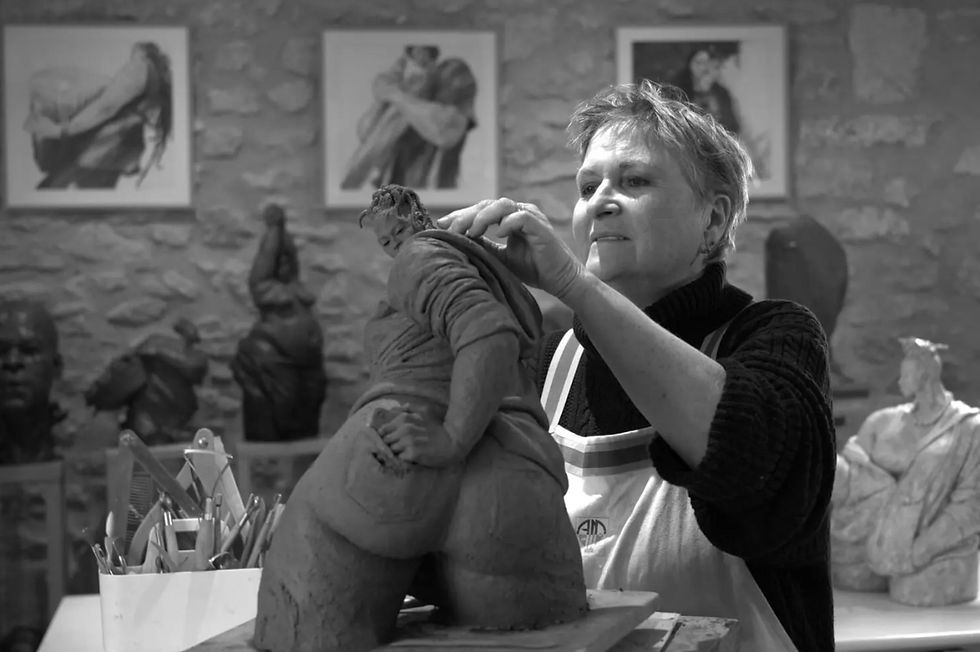
Anne Mourat’s works are primarily bronze casts created from clay models, giving form to an aesthetic that is both sensitive and assertive. She embraces a classical figurative approach, which she revisits with subtlety and playfulness, notably through slight disproportions. Through this lens, she explores and celebrates the human condition in all its strength and fragility.
After studying art in Paris and spending several years teaching and working in graphic design, Anne Mourat returned to sculpture in her forties, during what she calls her “African years.” Back in France in 2008, between two periods of expatriation in Senegal, she began exhibiting her work in art fairs, artistic gatherings, and galleries. She later became a permanent artist in several exhibition spaces across Africa, Europe, and the United States.
Now permanently based in France since 2021, she works from her studio-gallery in Provence.
You lived for several years in Africa. What lasting influence has that experience had on your way of creating?
I had experimented with clay modeling during my art studies in Paris, but it was almost fifteen years later, in Africa, that I truly began sculpting.
At first, it was purely for pleasure during my six years in Burkina Faso (I was then working as a freelance graphic designer and illustrator). During an informal internship with traditional bronze casters, I rediscovered the joy of working in volume and created a few wax pieces that local artisans later cast in bronze. Gradually, this medium became an obvious and essential form of expression for me.
In the early 2000s, shortly after arriving in Senegal, I decided to devote myself entirely to sculpture, working and exhibiting in Dakar galleries and as part of the OFF selection of the Dakar Art Biennale. During a few returns to France, I registered with the Maison des Artistes and also began exhibiting there.
My main source of inspiration is the human being in all its “forms,” and more specifically what I call the “life force” that I perceive — and that fascinates me — in people around me or those I meet by chance. And I must say that in Africa, I met many people who embodied that quality! When I began sculpting voluptuous women, it was because, in my daily life, I encountered women who, both muscular and full-bodied, radiated an incredible sense of power and grace. Embracing and owning their forms, they perceived themselves as both seductive and strong.
It was a cultural shock and a deep questioning of my own beliefs about what feminine beauty “should” be. Today, I have completely distanced myself from Western injunctions about an “ideal” female form. Whether my figures are slender or round, young or old, no longer matters — neither to me nor to them. They simply are — alive, present, in the moment.
In conclusion, I don’t know if my long African experience has influenced, as you say, my way of creating — at least not technically — but it certainly has shaped my perception of what human beauty is.


La Campée / La Secrète / La Jumbax-Out
How do you choose the subjects you sculpt? Do you always work from live models?
The answer to that is already somewhat contained in my previous response! Each time, it’s a genuine aesthetic “coup de foudre” — I’m captivated and moved, and it makes me want to celebrate what I’ve perceived of humanity and strength in these men and women.
I always work from models: friends, family members, or strangers I meet by chance. I have even approached strangers and asked if they would agree to pose for me! I explain what I do, invite them to visit my website, leave my contact information, and then wait for their call… which may or may not come!
Thanks to the quality of today’s phone cameras, I record numerous videos that I later download to my computer and work from alone in my studio. Of course, I reinterpret reality, playing with the slight disproportions mentioned earlier. Yet, despite these distortions, I remain very attentive to anatomical accuracy and resemblance. For me, all my sculptures are portraits — even the half-length ones (perhaps a reflection of my youthful passion for comic books?).
Why has the human figure become the heart of your sculptural work?
My work, resolutely figurative and serenely accepting of that fact, is devoted to celebrating humanity in all its power and fragility. I honestly couldn’t say why I chose the human figure — I simply have no desire to explore any other subject! Each new model is a meeting, a discovery, a moment of wonder, and I never tire of it.


Lolote
What importance do you give to material — clay, bronze — in your creative process?
My work begins with clay, since my technique is modeling. In the early years, I made (or had made) molds from my unfired clay originals, which were lost in the process of opening the molds. It was therefore necessary to create castings — preferably in bronze, of course, but also in resin or plaster.
For about ten years now, I have been firing my clay pieces, keeping an original in terracotta from which I may — or may not — make a mold.
Clay is a fascinating medium — both forgiving and demanding. A piece that hasn’t dried can always be reworked, reshaped. You can cut it, reattach it, remodel it — it’s always cooperative. But beware of air bubbles if you plan to fire it! It requires both attention and respect. The transformation through firing is, to me, an absolutely magical process. I also find it deeply moving to use such an ancient and universal medium. It gives me the feeling of belonging to an endless, natural continuum.

The bronze stage is important but secondary. Bronze allows a piece to endure and be enhanced, but it doesn’t intervene in the creative process itself. I don’t personally make the castings, of course, but I remain involved in certain key steps: overseeing the finishing touches on the first wax positive and, above all, during the final phase — the patina. I’m always present at the foundry when the patina is applied, because that’s when I feel, after all those technical stages, that I finally reclaim my piece

Your upcoming creations: what are your main sources of inspiration today? Do you think Provence will influence your work as Africa once did?
In my ongoing aesthetic and humanist exploration, I’m currently working on a series of female portraits in three-quarter view titled “Femmes/Objets” (Women/Objects). The title is, of course, ironic — it’s not about the compound noun femme-objet (“sex object”) with its negative connotation, but about placing the two words side by side. At first, this happened by chance (L’Accordéonniste, La Dame de Cœur, La Tassaba, A Mulher Do Meio, Pug-Panga), but more recently, I’ve done it deliberately and systematically (La Gardienne, L’Inattendue, Phœnoménale 1, Phœnoménale 2). I ask my female models to pose with an object of their choice — something meaningful to them — with the only condition being that it fits in one or both hands. Inevitably, the object influences the pose, and each woman, through her silent interaction with it, allows me to enter her intimacy and reveals a part of herself — whether private or public, intense or light.
In these moments, it’s no longer about how others look at them; the chosen object becomes a way to refocus on the essential, away from judgment and seduction. The body, however, is not forgotten — it is reclaimed. It’s in this intimate relationship with themselves that their life force is revealed. Whether subtly understated or triumphantly asserted, I tirelessly seek to capture and elevate that vitality, sculpture after sculpture.


La Tassaba / Phoenoménale 2 / L’Accordéoniste
If you could keep only one of your works, which would you choose, and why?
After much thought (it’s quite a cruel question!), I believe I would choose Petit Instant d’Éternité (A Small Moment of Eternity). “Éternité is an anagram of étreinte,” wrote Henri de Montherlant… This piece speaks the most about me — perhaps also because of the very personal story behind it. It touches on the essence of our human condition: the need for love and connection, interiority, intimacy, the present moment. It’s also the one that has provoked the strongest reactions from viewers — and it’s always a joy for me when one of my sculptures moves someone emotionally.
I also love the overall balance of the piece — between hands, faces, and body — and, finally, it was one of the most technically delicate works to make, so I’m proud of it!

To discover more of Anne Mourat’s works, visit his website at https://www.anne-mourat.com/ and follow his latest updates on Instagram @anne_mourat_artiste

Comments